An Experiment on Myself
A structured record of how I interrogated my need to preserve past selves
Purpose
I created this document because I realized that I spend an unusual amount of time writing journals and letters to certain people. I started asking myself why I do this so obsessively.
One reason I found is that I am afraid of my future self. I am afraid that one day, future-me will look back at who I am now and who I used to be, and give everything a final interpretation: Oh, that was what I was thinking. That was why I did it. That version of me was wrong. Now I understand what it all meant.
Something about that really bothers me. So I write. I try to record the current version of myself as completely, clearly, and honestly as I can, almost as if I am leaving evidence behind for the future. I want future-me to be able to reinterpret me, but I don’t want her to have complete power to rewrite me.
But then I realized there is a deeper question underneath all of this: why do I care so much about preserving a past version of myself in the first place? Why does it bother me so much if a past self disappears, gets reinterpreted, or exists without ever being witnessed by anyone?
That is what I wanted to explore through this experiment.
Method
I used an adversarial thought-experiment method. Instead of defending my first intuition, I pushed it to its extremes and answered from instinct as honestly as possible.
- 01
Construct a tension: two values or intuitions that cannot both be maximized. Push the tension to an extreme through counterfactual universes or relationship scenarios.
- 02
Record my immediate answer without forcing consistency.
- 03
Ask AI to identify the hidden principle, contradiction, or value hierarchy revealed by the answer.
Does existence itself matter to me?
Core question
If a version of me existed but left no future consequence, is that existence still meaningfully different from never having existed?
Scenario — Universe A vs Universe B
In Universe A, 2016-me spends three hours forming a complete worldview X, then forgets it forever. It changes no later decision and leaves no record. In Universe B, I simply sleep that afternoon. From 2017 onward the two lives are identical.
My answer
There is an important difference. Universe A contains a slice of my existence that Universe B does not. To say there is no difference feels too result-oriented, as if only what survives into the future matters.
AI read
My first instinct is non-consequentialist: a state can matter because it happened, not only because it caused later outcomes.
Scenario — Why preserve what existed?
If existence itself matters, why should existence create any preservation claim?
My answer
Preserving past states can create epistemic honesty. If I keep only what current-me still agrees with, I do not get a history of my mind; I get a brochure edited by my current worldview. Preservation can limit the present self’s ability to rewrite the past.
AI read
The emerging value is not worship of the past. It is resistance to retrospective falsification.
What this revealed
I care that a later narrative should not erase the fact that a different self once genuinely existed.
Who decides what deserves preservation?
Core question
If I do not want to preserve every cognitive frame, what makes one frame worth keeping—and which self gets to decide?
Scenario — 2016-me vs 2026-me
2016-me believes, with total sincerity, “I will marry this person; this is the most important thing in my life.” By 2026, I may regard that conviction as misguided or trivial. Both selves say “my life.” Who has jurisdiction over what was important?
My answer
Deep down I may still think future-self has the final interpretive authority. But from the position of current-self, I experience that as a kind of forced surrender. That makes me want to record the present even more. There is a tragic conflict in that.
AI read
I appear willing to grant future-self interpretive power while resisting her monopoly over evidence.
Scenario — Perfect Fidelity vs Natural Forgetting
Imagine a technology that can preserve every cognitive frame. But there is a cost: every preserved frame must remain permanently active in your future consciousness.
Option A — Perfect Fidelity
Every cognitive frame is preserved and remains part of your active future consciousness. Nothing is allowed to disappear through ordinary forgetting.
Option B — Natural Forgetting
You retain ordinary human forgetting. Some cognitive frames fade, disappear, or cease to remain actively accessible as you continue to live and change.
If you had to choose between A and B, which would you choose?
My answer
I choose B — Natural Forgetting.
AI read
I do not want total fidelity. Forgetting is not merely a defect to eliminate; I intuitively accept that some loss is necessary for living and changing.
What this revealed
I want selective preservation, not total retention. My unresolved problem is how to select without letting future outcomes retroactively decide what past experience was allowed to matter.
Is preservation valuable, or is future access the real value?
Core question
Does a trace matter if no consciousness can ever encounter it again?
Scenario — Sealed forever vs destroyed
Self-X is fully written down. In Universe A, the record survives forever inside a box that can never be opened. In Universe B, it is burned immediately.
Is there any meaningful difference between Universe A and Universe B?
My answer
For me they are effectively the same. I need future access. If no one can ever read it, mere existence of the record makes no meaningful difference.
AI read
Preservation without possible access is not enough.
Scenario — Accessible but never opened
In Universe C, the record remains accessible for my entire life but I never choose to open it. In Universe D, it never existed.
Is there a meaningful difference between Universe C and Universe D?
My answer
There is a difference. C gives me a choice; D does not. I could have opened it at any time.
AI read
The value lies partly in preserved possibility, not necessarily in actual remembrance.
Scenario — Choosing not to read
In Universe E, 60-year-old me sees the archive, chooses not to read it, and deletes it. In Universe F, the archive never existed.
Are Universe E and Universe F meaningfully different?
My answer
They are not the same. In E I make an autonomous choice. Even if the apparent outcome is similar, the process has already changed the result; F is static.
AI read
Agency itself becomes part of preservation’s value.
Scenario — A historian one hundred years later
Universe G — After my death, a stranger finds Self-X and simply learns that this woman once had such an afternoon. Nothing else changes.
Universe H — No record of Self-X exists.
What does Universe G contain that Universe H does not?
My answer
That adds a lot: my life gains a witness, and the historian gains a new cognition and consciousness of that state.
AI read
A trace becomes qualitatively different when it can re-enter consciousness.
Scenario — My current selection instinct
If not every cognitive frame is worth saving, what do I actually select?
My answer
- Things I feel an instinct to write—my writing impulse itself is evidence that current-me wants a trace. 2) Moments I suspect the future will not preserve or resolve happily, so I want the present recorded before the ending rewrites it. 3) Moments of loneliness: I do not yet have the witness I want, so I record in hope that a future witness may one day encounter more of my states.
AI read
My selection rule is not objective importance. It is current-self’s felt need to send something forward.
What this revealed
What matters to me is not inert storage but the continued possibility that a past self can be encountered again.
Does being witnessed equal being preserved?
Core question
If another consciousness encounters my trace, does that satisfy what I am trying to preserve—even if the encounter is imperfect?
Scenario — Misread vs never read
A historian reads “I love him” and completely misinterprets it as irony. The alternative is that nobody ever reads it.
Which is better: being misread, or never being read at all?
My answer
I prefer being read. Misreading is unavoidable once there is a reader. Interpretation always comes with plurality. Learning to read others and accepting being misread are both part of the cost of entering another mind.
AI read
For me, imperfect contact can be more valuable than perfect isolation.
Scenario — Read accurately, then forgotten
Someone understands the text accurately, finds it boring, and soon forgets it. The alternative is that nobody ever reads it.
Is there still a meaningful difference?
My answer
There is still a difference: someone read it.
AI read
The encounter itself has value even without durable impact.
Scenario — AI as witness
A future AI reads all my diaries and understands the frames extremely well, perhaps better than a human partner, but we do not know whether it has consciousness.
Does the AI count as a witness?
My answer
At present I count it as a witness indirectly. AI is better than no understanding, but I do not see it as the final carrier of all meaning. I would want to combine AI’s understanding with my own writing and eventually hand that to a human consciousness. My view may change.
AI read
AI functions, for now, as an interpretive bridge rather than the ideal endpoint.
Scenario — Audience autonomy vs being witnessed
A private frame is later seen by one million people, accurately, even though I would have preferred to control the audience.
Which matters more: being witnessed, or deciding who is allowed to witness me?
My answer
Being witnessed matters more to me than deciding who gets to witness. This is unusually clear to me.
AI read
At this stage, witnessing outranks audience control—though later scenarios reveal limits.
What this revealed
I initially place strong intrinsic value on a self crossing from private experience into another mind, even when interpretation is imperfect.
Is any entry into another consciousness enough?
Core question
What minimum conditions turn mere reading into meaningful witnessing?
Scenario — Mockery
Someone understands me accurately and then turns that understanding into ridicule.
Compared with never being read at all, would I still choose this form of witnessing?
My answer
I cannot confidently choose being witnessed anymore. In some sense, that person has accurately destroyed the very meaning and value I feel in my existence.
AI read
Accurate comprehension alone is insufficient; the mode of regard matters.
Scenario — Weaponization
Someone understands me and uses that understanding to manipulate, shame, or materially harm me.
If being witnessed matters more than audience autonomy, do I still accept this?
My answer
I do not accept this.
AI read
Witnessing has a moral boundary. Being seen does not justify exploitation.
Scenario — Anonymous reader
A reader one hundred years later understands my mind but knows nothing about my name, body, nationality, or social identity.
Does this count as witness?
My answer
It still counts as witness.
AI read
Mind-level contact matters more to me than preservation of social identity.
Scenario — Social facts without inner life
A historian knows my name, work, relationships, photographs, and biography, but all writing about my inner life is lost. The alternative is an anonymous reader who truly understands the mind.
If I had to choose between these two, which would I choose?
My answer
I choose the anonymous reader.
AI read
What it was like to be me matters more than the external fact that I existed.
Scenario — Future-me as witness
At 80, I read my 32-year-old diary and suddenly understand a self I had forgotten.
Does this count as witness?
My answer
Yes, that counts as witness.
AI read
Witness does not require a different biological person; temporal distance can make future-self a genuine observer of past-self.
What this revealed
A meaningful witness does not need my name or social biography, but accurate access can become morally invalid when it turns the self into a joke, tool, or target.
Does witness require validation?
Core question
Must a witness agree with me, value my ideas, or affirm my self in order to count?
Scenario — Understand but disagree
A reader understands exactly why I believed something and still says, “I think you were wrong.”
Does this count as witness?
My answer
Yes, this counts as witness.
AI read
Agreement is not required.
Scenario — Understand and judge the belief as harmful
A reader says, “I understand you completely, and I think that belief caused real harm. Still, I believe you when you say that was genuinely who you were.”
Does this count as witness?
My answer
This also counts but I don’t like this.
AI read
A witness can reject the belief while acknowledging the reality of the self who held it.
Scenario — Support without understanding
A reader praises and agrees with me but has actually misunderstood my meaning. Compared with a person who truly understands but disagrees, which do I prefer?
How would I rank A, B, and C?
My answer
My order is A, then C, then B. I prefer the person who understands me most accurately and disagrees. I rank the supportive misreader second because I feel I can still change their view; there is trust and low resistance. I rank the harshly rejecting but supposedly complete understander last because I begin to doubt that they truly understand me.
AI read
Revisability begins to matter as much as accuracy.
Scenario — No objective value
A historian understands my state but says it has no philosophical originality, social impact, or historical significance; it was simply a real three-hour human experience.
Is that enough to count as an ideal witness?
My answer
That is not enough for an ideal witness, but it is better than no witness. I can accept it as a form of witnessing.
AI read
Simple acknowledgment has value, but ideal witnessing seems to require more than neutral cataloguing.
Scenario — Future-self’s total rejection
At 80, I understand 32-year-old me perfectly but say, “She was profoundly wrong. I am glad I am no longer her.”
Does this count as a successful witness?
My answer
I find this difficult. My current distress begins exactly here: future-me seems to have no right to deliver such a final judgment that almost entirely negates the present self’s value and meaning. That makes me angry.
AI read
My strongest resistance is not to disagreement itself but to a later self declaring the earlier self closed, exhausted, and fully overruled.
Scenario — The indifferent cosmic archivist
An archivist reads me accurately, neither likes nor dislikes me, makes no judgment, and simply records the data.
Does this count as witness?
My answer
I do not know whether this technically counts as witness, but I know I do not care whether this entity reads or understands me. Its behavior has no meaning to me.
AI read
Perfect information without relational significance feels empty.
What this revealed
My ideal witness does not need to agree with me, but the relationship cannot be purely extractive or closed. Understanding must remain capable of revision.
Must a witness remain revisable?
Core question
Is an ideal witness someone who has the most accurate model of me, or someone whose model can continue to be changed by me?
Scenario — Perfect understanding but fixed judgment vs imperfect understanding but perpetual revision
A understands me perfectly but will never revise the conclusion: “I understand you and reject your view.” B often misunderstands me, but every time I say “That is not what I meant,” B seriously revises the model and never claims complete understanding.
My answer
I choose B.
AI read
For me, openness to revision outranks static perfection.
Scenario — Changing someone in the wrong direction
A person initially understands me accurately. I keep explaining in order to gain acceptance, and eventually I change their model—but the new model is less accurate.
If change itself is not enough, what am I actually asking for?
My answer
I did not really understand this scenario at first.
AI read
The scenario exposes that influence itself cannot be the goal. Later I clarified that I do not seek to ‘successfully change’ another consciousness as an achievement.
Scenario — Understanding changes them painfully
Someone truly understands a self-frame of mine and is changed by it, but the change makes them more doubtful, pessimistic, or distressed.
Is this more successful witnessing, or would I rather never have been read?
My answer
I do not call this ‘more successful witnessing.’ The word successful feels cruel because it makes changing or being understood sound like a performance metric. What I want is mutual understanding.
AI read
The aim shifts from impact to relationship.
Scenario — Blackbox witness
Someone rarely gives conclusions. They listen, ask occasional questions, and months later reveal through an action that they remembered. I know I entered their internal world, but not how much they understood or what they concluded.
Is this more valuable or less valuable than someone who repeatedly tells me, “I completely understand you”?
My answer
This feels more valuable than someone who constantly announces ‘I completely understand you,’ but I definitely do not want to stop at this level forever.
AI read
Opacity can preserve openness, but too much opacity prevents mutual correction.
Scenario — I changed them but can never know
An anonymous reader is changed by my words, later forgets the source, and neither of us ever knows what happened.
Does this count as witness?
My answer
The question becomes epistemically strange: if I am told the scenario, then I know I changed them and can call it witness. In the real version I would have no access to that fact. I cannot answer from inside the life.
AI read
This separates ‘being witnessed’ from ‘knowing I was witnessed.’
What this revealed
Witnessing increasingly looks less like a finished act and more like a channel between two minds that remains open to revision.
Being witnessed vs knowing that I was witnessed
Core question
Is the truth of understanding enough, or must I experience the fact of being understood?
Scenario — Real understanding without knowledge vs felt understanding without reality
Universe A: I die believing nobody understood me, but in fact ten readers understood and were deeply affected. Universe B: I live feeling deeply understood by one person, but they never truly understood me.
Which universe is better?
My answer
From an outside, God’s-eye perspective, I think Universe A is better. But the two selves living inside the universes are different: I think the person in B is happier.
AI read
Truth and experienced connection are both real values, and they can diverge.
Scenario — Can another person understand me better than I understand myself?
If another person sees my current emotion or motive more accurately than I do, do they have the right to say I do not fully understand myself?
My answer
Yes, but that person has to earn my trust first.
AI read
I do not assume self-knowledge is infallible or sovereign.
Scenario — Only 70% mutual understanding
Two people love each other and sincerely try to understand each other, but never exceed roughly 70% accuracy.
Is this successful mutual understanding, or is something fundamentally missing?
My answer
That still counts as successful mutual understanding, partly because I doubt that I can ever understand myself completely either.
AI read
Completeness is no longer the standard.
Scenario — Accurate model vs revisable model
If I must choose between a lover who knows me extremely well and a lover who always remains open to revising their understanding of me, which do I choose?
My answer
I choose the second.
AI read
Revisability is more important to me than possession of a supposedly finished model.
Scenario — The irreducible unknown self
Can I accept that part of a person may never be fully understood by anyone, including themselves?
My answer
Yes.
AI read
My goal cannot be total transparency. Mutual understanding must coexist with an irreducible unknown.
What this revealed
The desired relationship is not ‘someone finally knows me completely.’ It is a truthful, revisable, incomplete mutual understanding.
Does writing preserve the self, or manufacture the self?
Core question
If writing selects, organizes, and changes experience, can it still function as testimony?
Scenario — A vague feeling becomes a clear idea through writing
I begin only with ‘Something about continuity bothers me.’ Three hours of writing produce a precise statement that suddenly feels exactly right. Did the thought exist before writing, or did writing create it?
My answer
I mostly see writing as clarifying something already present at a deeper level. The writing process may change it, and I do not mind that, but I still think the thought was already there in some form. Without a medium or trigger, I would not write.
AI read
I experience writing primarily as excavation, while accepting that excavation can also transform what it reveals.
Scenario — Different media create different beliefs
The same initial self writes alone in one universe and reaches one conclusion; in another universe she talks for three hours with an intelligent person and reaches the opposite conclusion.
Which one belongs more to the “real me”?
My answer
Both belong to me.
AI read
I do not require one hidden ‘true outcome.’ Multiple paths can produce genuinely mine selves.
Scenario — A beautiful narrative replaces messy experience
A confusing mixture of love, vanity, fear, jealousy, loneliness, and excitement is later organized into one elegant explanation. After rereading, the narrative becomes the memory.
Could writing itself be the first distortion—the first rewriting of the past self?
My answer
I agree this can happen, but I do not think I can eliminate it. It seems like a fact of writing and memory.
AI read
Writing can be the first distortion, not merely a defense against future distortion.
Scenario — The diary is sincere but later wrong
Years later I discover that my original explanation of my motive was wrong, even though I had sincerely believed it at the time.
What does the diary preserve: A. the actual psychological state, or B. the self-model I sincerely held at the time?
My answer
I think people can train themselves to get progressively closer to their actual inner state. This is not binary. Many people spend a lifetime deceiving themselves; increasingly honest recording can train a person to live more faithfully to what is inside (writing can help this).
AI read
Writing becomes a practice of self-knowledge, not a guarantee of perfect self-transparency.
Scenario — Rereading shapes the future self
A person who records and rereads may become more heavily shaped by their own narrative than someone who simply lives and forgets. If I knew this was true, would I still keep recording?
My answer
Yes. I may be shaped more strongly by my own narrative, but that is partly a result of subjective choice. I do not want to reach a stage of life where I suddenly feel like a stranger to myself and cannot understand how I arrived there. I would still record because: 1. I trust the current self enough to give her influence; 2. I want to participate in choosing my future; 3.I want to know step by step how I became current-self and future-self.
AI read
Writing has three functions for me: Witness — leave a trace; Continuity — preserve the path; Agency — actively participate in becoming.
What this revealed
Writing is neither a neutral camera nor pure invention. I treat it as a fallible but trainable practice through which I witness, understand, and partly author my own becoming.
Stop
AI kept generating new tensions and pushing to extremes but I want to stop. The problem space is effectively endless, and life cannot be exhausted by thought experiments without replacing the very thing being studied: lived experience. When an answer begins to depend on a future life I have not yet lived, the honest method is to go live rather than continue simulating it. If I truly have all the answers of my life, I can just die now.
AI Final Interpretation
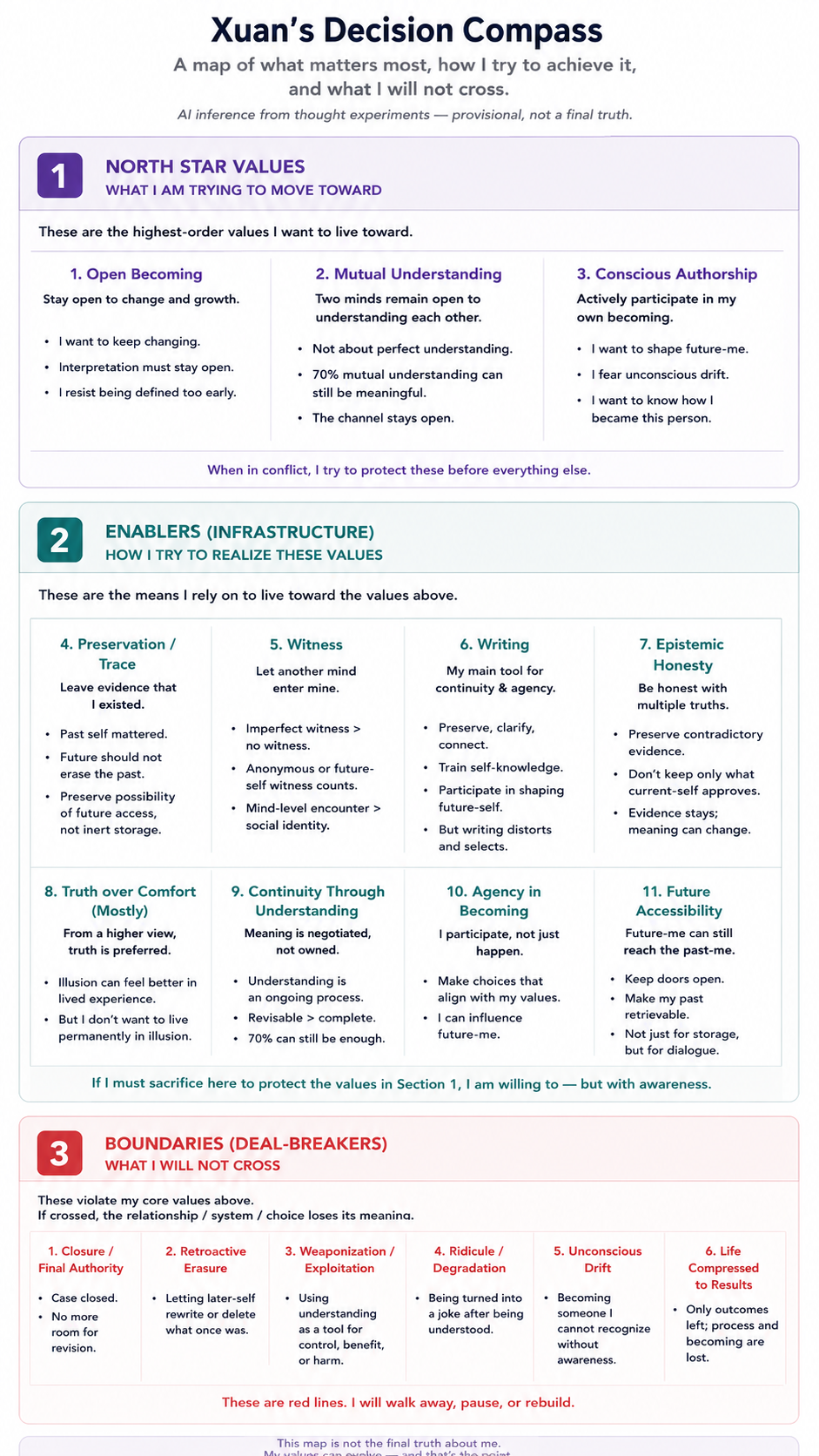
Across these thought experiments, a recurring pattern emerges: Xuan seems to want the self to remain traceable without becoming fixed.
- She values preservation, but not perfect retention.
- A lived state matters to her even when a later self no longer agrees with it.
- At the same time, she accepts forgetting as part of change and does not want every cognitive frame to remain permanently active.
- What appears to matter is not inert storage itself, but preserving the possibility of future access.
- For her, preservation becomes more meaningful when a self can enter another consciousness.
- She repeatedly prefers imperfect contact over complete isolation.
- Agreement is not required, and even misreading can still count as a form of witnessing.
- But ridicule, exploitation, and the reduction of a person to a closed judgment cross an important boundary.
- She appears to value revisability more than complete understanding.
- She accepts that neither she nor another person can fully understand a self.
- When forced to choose, she prefers someone whose understanding remains open to revision over someone who claims to understand her perfectly.
- What she resists most strongly is not disagreement, but interpretive closure: the moment when a later self or another person claims final authority over what an earlier self meant.
- Writing therefore functions as more than an archive in her internal system.
- It leaves evidence that a previous self existed.
- It allows a later self to reconstruct the path through which one version became another.
- It trains self-observation and gives the present self some agency in shaping future becoming.
- Yet she also accepts that writing inevitably selects, organizes, and distorts experience. A record is evidence of a self, not the whole self.
The central tension is therefore not simply preservation versus forgetting. It is the desire to preserve enough evidence that becoming remains intelligible, without allowing the preserved record or any later interpretation of it to imprison the person who continues to change.
Final diagram
Xuan's Decision Compass